 KAUAI TODAY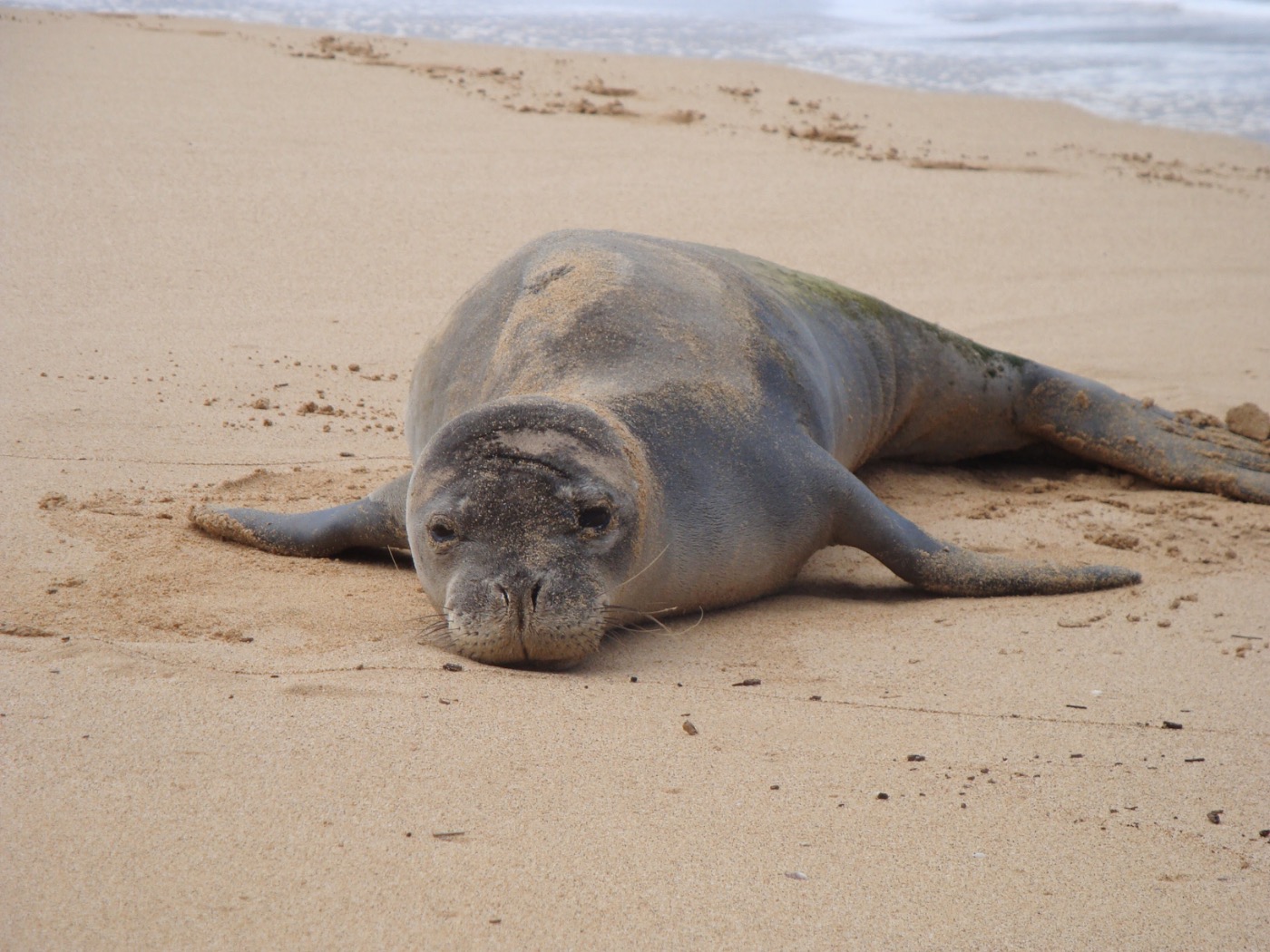
If you've ever rounded a corner on a Kauai beach and found a large, motionless grey animal on the sand — and felt your heart jump — you've met the ʻĪlioholoikauaua.
That's the Hawaiian name for the Hawaiian monk seal, and it translates to "dog that runs in rough water." It's also one of the rarest marine mammals on the planet.
There are approximately 1,600 Hawaiian monk seals left in the world. That's it. They exist nowhere else on Earth — endemic to the Hawaiian archipelago from the Big Island all the way up to Kure Atoll, 1,500 miles of Pacific. Around 400 of them live in the Main Hawaiian Islands, which means Kauai, Oahu, Maui. The rest are out in the remote Northwestern Hawaiian Islands, far from most human contact.
They are the only monk seal species that survived into the modern era. Two others — the Caribbean monk seal and the Mediterranean monk seal — are extinct or critically rare. The Hawaiian monk seal is the last of its kind.
THE ONE ON YOUR BEACH ISN'T SICK
This is the most important thing to know: a monk seal hauled out on the sand, eyes half-closed, not moving much, is almost certainly fine. They rest. For hours. Sometimes all day. It's what they do between deep ocean dives for fish, eels, and octopus. They are not stranded. They do not need water poured on them. They do not need help.
What they need is space.
THE RULES — AND THEY'RE FEDERAL
Hawaiian monk seals are protected by the Endangered Species Act, the Marine Mammal Protection Act, and Hawaii state law. Getting too close isn't just bad etiquette — it's a federal offense, with fines and potential jail time.
Stay 50 feet away minimum. NOAA's rule of thumb: close one eye and extend your thumb. If your thumb covers the seal, you're far enough. If it doesn't, back up.
If there's a mother with a pup: stay 150 feet away. Mom is protective, pups are vulnerable, and the early weeks are critical to survival.
Don't feed them. Don't touch them. Don't pour water on them. Don't let dogs approach them. If you see a seal being harassed, report it to NOAA's hotline: 1-888-256-3962.
WHY THEY MATTER
The threats facing monk seals are real: entanglement in fishing gear, toxoplasmosis (a parasite spread through cat feces that reaches the ocean via runoff), shark predation, loss of low-lying pupping beaches to rising seas. Recovery is slow — the population has grown, but only barely, and every seal counts.
NOAA's Pacific Islands Fisheries Science Center runs active recovery programs: pup translocations, morbillivirus vaccinations, and aerial monitoring by drone. In May 2026, a pup born to a female named RK96 — known locally as Kaiwi — was reported thriving and on track for weaning.
Progress, one pup at a time.
WHAT TO DO WHEN YOU SEE ONE
Stop. Watch from a distance. Feel lucky — most people on Earth will never see one of these animals in the wild. Take photos from where you are. Tell your group to stay back. And if there are no ropes or signs up yet, create a buffer zone yourself.
The ʻĪlioholoikauaua has been hauling out on Hawaiian beaches for 15 million years. They were here long before we were. Give them the beach.
---
To report a seal in distress or being harassed: NOAA Hotline 1-888-256-3962
For updates on monk seal recovery: fisheries.noaa.gov/species/hawaiian-monk-seal